 Fixedfloat
Fixedfloat refunds after order expiry and network fee deductions
Fixedfloat refunds can return a deposit received for an expired order to your specified address, minus the network fee. The order may also offer continued exchange at a revised market rate. Payment errors and screening holds follow different procedures, which can change eligibility, costs, and timing.
Last updatedKey takeaway: An ordinary expired-order refund returns the deposited asset, so its destination must accept that asset on the return network.
Expired orders and the return option
During an ordinary exchange, the service receives the expected deposit, waits for any required confirmations, and sends the exchanged asset to its destination. When an expired order recognises a late payment and offers both actions, its recovery choices are continued exchange at updated pricing or a return. Choosing a refund concerns the deposited asset, while continuing concerns the asset that the exchange would deliver.
The payment countdown governs the original funding window. It does not promise when a refund will reach your wallet. Fixed-rate conditions also require the correct deposit amount and acceptable market movement before the payment appears on the network. A failed condition can replace the original quote with a choice about the incoming funds.
Deposits received before 24 hours from order creation automatically appear in the order. An unpaid order has no funds to return.
How much of an expired-order deposit comes back?
An ordinary expired-order refund returns the received deposit after deducting the network fee for sending it back. A manual recovery can involve other charges under the rules for that particular payment error.
The original payment and its return are separate transfers. Your sending wallet or platform may charge for funding the order, while the refund creates another network payment. Compare the refund with the amount that the order actually received. The total debit from your sending account can include its original transfer fee, which is outside that received amount.
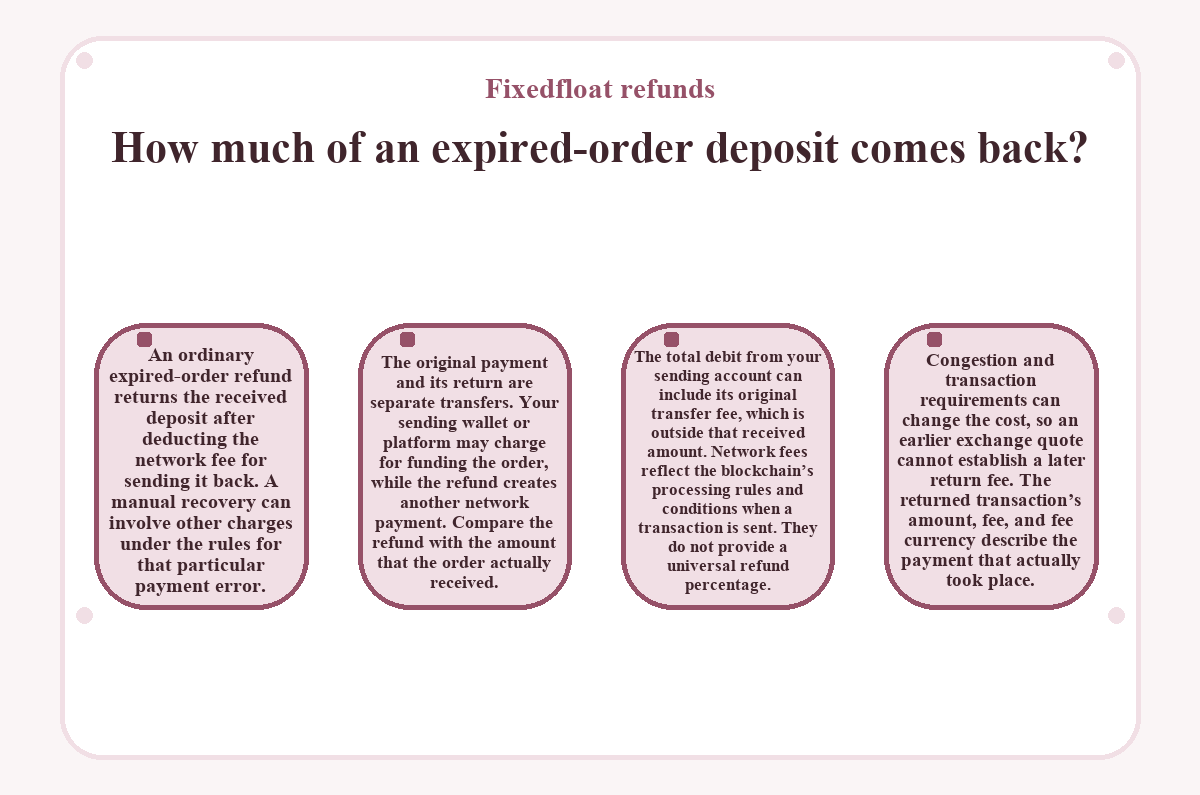
Network fees reflect the blockchain’s processing rules and conditions when a transaction is sent. They do not provide a universal refund percentage. Congestion and transaction requirements can change the cost, so an earlier exchange quote cannot establish a later return fee. The returned transaction’s amount, fee, and fee currency describe the payment that actually took place.
A destination for the deposited currency
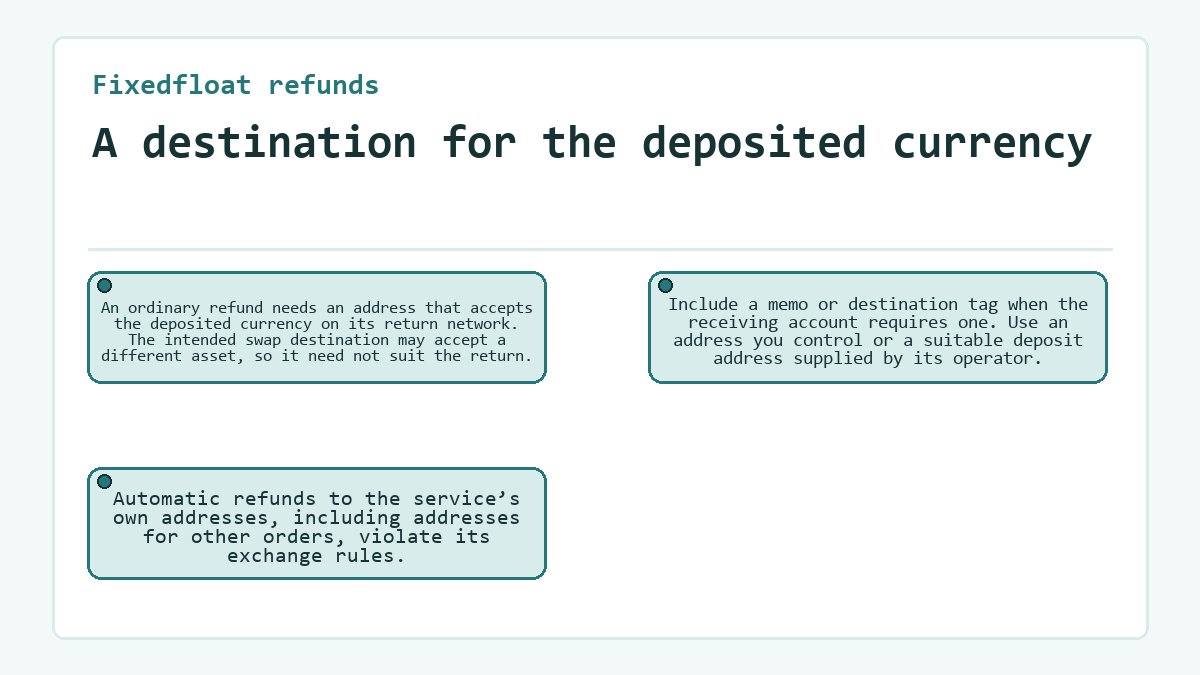
An ordinary refund needs an address that accepts the deposited currency on its return network. The intended swap destination may accept a different asset, so it need not suit the return. Include a memo or destination tag when the receiving account requires one. Use an address you control or a suitable deposit address supplied by its operator. Automatic refunds to the service’s own addresses, including addresses for other orders, violate its exchange rules.
A late deposit and a fresh exchange attempt
In this hypothetical case, which option lets a customer recover a predictable amount of the deposited asset: continuing a late-funded order or refunding its deposit? The expired order has recognised a correctly addressed payment and offers both options. Its credited deposit totals 2.734 units of the deposited asset. Assume a refund network charge of 0.006 units in that same asset, with no manual recovery charge.
Continuation uses updated market pricing for the requested asset. A refund returns the deposited asset after its network deduction. The choice concerns different currencies, so their raw unit amounts cannot establish which option has greater value.
The customer chooses the refund to recover a known quantity of the original asset under these assumptions. Subtracting 0.006 from 2.734 gives a net return of 2.728 units. This uses the deposit credited to the order, excluding any original sending fee. A different return charge would change the net amount.
The order records the refund selection and destination; later, the return transaction and receiving wallet confirm the 2.728-unit credit. After the previous order finishes, a fresh attempt uses a new order’s payment details, amount, and countdown. The customer also reassesses the sending fee before paying. Reusing the expired quote would leave the original timing problem unresolved.
What confirms that a refund has actually been sent?
A return transaction visible on its network shows that the payment was submitted, while a recorded refund choice confirms only the requested action.
API v2 supports refund selection for an order in the EMERGENCY state, where customer action is required. A successful emergency-action response confirms that the service has set the order’s chosen action. Refreshed order details provide separate return-transaction information, including its identifier, amount, network fee, and confirmations.
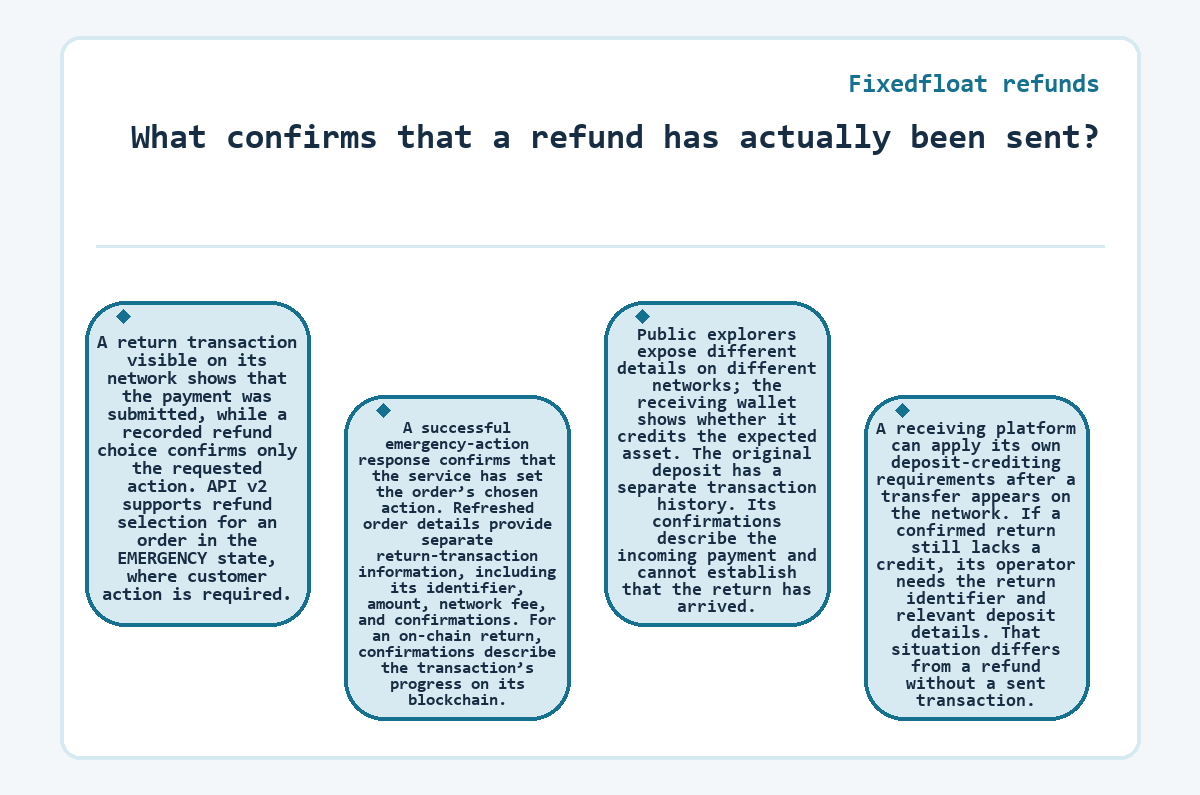
For an on-chain return, confirmations describe the transaction’s progress on its blockchain. Public explorers expose different details on different networks; the receiving wallet shows whether it credits the expected asset. The original deposit has a separate transaction history. Its confirmations describe the incoming payment and cannot establish that the return has arrived.
A receiving platform can apply its own deposit-crediting requirements after a transfer appears on the network. If a confirmed return still lacks a credit, its operator needs the return identifier and relevant deposit details. That situation differs from a refund without a sent transaction.
Manual recovery for payment errors
Payments sent after 24 hours from order creation need manual matching through support.
The order processes only the first deposit; extra payments need separate handling.
If FixedFloat supports both the deposited currency and network, support can manually match a wrong-currency or wrong-network payment for exchange or refund. Unsupported-currency or unsupported-network payments have refund-only recovery, subject to minimums, fees, and refusal rights. Deposits at or below the applicable recovery minimum do not qualify. Unsupported-network recovery requires a separate processing-fee payment in that network’s native cryptocurrency to the original order address on the same network. Unsupported-currency recovery on a supported network carries a service charge and a return network fee. The current recovery terms specify each error’s minimum, fee, and processing period.
Missing required memos or tags can cause permanent loss. Recovery needs sender evidence and may be refused.
Screening holds and refund restrictions
A screening hold can suspend processing while the service examines the origin of funds. Selecting a refund does not bypass that review. Some exceptional anti-money laundering cases require sender evidence and identity verification before a return exclusively to the original sending address. Those restrictions differ from choosing a destination for an ordinary expired-order refund.
For an on-chain deposit, confirmations describe the blockchain transfer. An order can remain suspended after those confirmations if its review is unresolved.
Things people ask about Fixedfloat refunds
Does an incorrect fixed-rate deposit amount make a refund possible?
An incorrect fixed-rate payment amount can trigger a choice between refund and continued exchange at updated pricing. The required payment must match the order amount. Refund eligibility also depends on exchange limits: a deposit below both the order amount and the minimum has an automatic-refund option, but FixedFloat may refuse it. The current exchange form shows the applicable limits.
Can I receive email updates about an order awaiting a refund?
You can subscribe to email notifications about changes in an order’s status. Notifications help you follow the order without keeping its page open continuously. An email update reports a status change; the return transaction and receiving account establish whether the funds have arrived.
How long does an expired-order refund take?
An expired-order refund first requires the service to receive the deposit, followed by processing of its return. Network conditions affect that wait. A manually recovered payment follows the conditions for its particular error, and its processing period may start from a registered request or completed evidence submission.
Which API amount describes the transaction that was returned?
The back.tx.amount field describes the returned transaction amount. Its associated fee and fee-currency fields describe the network charge separately. Keep the returned asset, transaction amount, and fee currency distinct when reconciling records; a planned refund amount alone does not establish the payment that reached the recipient.
Does a deposit above the maximum exchange limit require a full refund?
An over-limit deposit can allow a return of the excess above the original order amount while the rest exchanges. If that automatic return fails, contact support; this manual refund goes only to the original sending address. This partial return differs from refunding the received deposit of an expired order.